Terrell Scott-Catcheway - Navigating the Environment

(0:00:00) I'm just going to introduce myself once again. I'm Terrell Scott Ketchaway and this is my first year within the program. The first picture was taken down in the Mordern Valley. So far I've been just taking pictures, so many, where I have nearly 200 photos.
(0:00:29) There you go. So far my presentation will all be about a wake-up call to all the plants that we've encountered. And so far I'll be naming them all in common language, no scientific terms. And I'll also be categorizing them to backyard plants to wilderness plants. And then I'll also be talking about berries.

(0:00:57) And we'll also be talking about the harm certain plants can cause to us and the environment. And then I've also learned ways to prevent the harm and lower their numbers. So far, backyard plants is what we typically see on disturbed grounds, such as mowed lawns, school parks, beaches.
(0:01:26) And then wilderness plants are typically seen beyond the bush line. Campground trails count as one of them as they're seasonal and also by lakes where there's no docks. And then backyard plants, so far I've listed a few. The thistle plants are there, beeping thistle, the purple flowers, perennial sowed thistles with the yellow flower.


(0:01:56) Common plantain, foxtails, burrs, and stinkweeds. So here's a creeping thistle. It has many purple flowers as it's ready to seed. These thistles can cause discomfort upon skin contact. Some can even...
(0:02:22) Get some of their thorns lodged into your skin. Had a few happen to me. You can easily be disposed of by just taking out the roots and the seeds. You can take care of that somewhere else. And it can grow in various sizes. I often see them just about knee height. And some can get extreme where they can go taller than me.
(0:02:51) and here is a common plantain plant that's commonly found on disturbed grounds i find the most on road trails so far the leaves it looks like basil leaves basil leaves kind of branch downwards but plantain branches upwards it also has many seeds on the head there that's what that indicates and it also has medicinal properties. The leaves are very useful in many ways, such as teas and herbs.

(0:03:18) Here's stinkweed. It's indicated by its leaf structure. I mostly find it noticeable by its shape. I imagine it as broccoli, but flattened.
(0:03:47) And the color, it's more unique than all the grass, as grass is green, but stinkweeds is a distinct bluish. It's also very common. You can see it pretty much everywhere, even on cut grass. It could also cause an allergic reaction due to the aroma it gives off. I think most noticeably is whenever it's cut or crushed.
(0:04:15) And it's also pretty competitive with the plants that it's nearby, as it takes up all that energy around it and kills all the other plants nearby.

And then burrs. I've also noticed, I thought this was just always like a plant or a branch or something, but no, it turns out those are seeds. Spiky hooked seeds that latch onto it.
(0:04:44) clothing and animal food and i often very found them very often on burdocks the plants with such a big large leaves and...

then green foxtails uh funny thing is we had to switch the picture i think i had to switch it about four times
(0:05:13) I'm often mistaken as tall grass because when it's not in seed, it just looks like your ordinary grass out in the fields. But when it's in its seed stage, it has this fuzzy stem onto it. Kind of reminds me of like a brush in a way. It's also considered a weed, how often...
(0:05:42) You can see it in the fields, as it also kills off other nearby plants. It is also a danger to animals, so if they were to ever consume it, they just get stomach problems, sick, and could cause harm. It can easily get lodged into their nostrils or between their teeth.

(0:06:11) And this is an example of a backyard plant, I guess. You can see how disturbed the ground or the area is. Cut grass on a road, on a clear setting. This picture was taken in La Riviere area.

The wilderness plants.
(0:06:41) So far, I listed a few, but there's many more out there. Poison ivy, as I consider that one here, as it has many variations out in the bushes. We also got Indian hemp, water hemlock, wild and cow parsnip, wild grapes, and yarrow.

(0:07:09) So our first plant would be water hemlock. It is often located within the wet soils, nearby marshes and lakes. It can also look like another plant. One of them that could be mistaken is maybe wild carrot. Wild carrot is more hairy and more bushy, meanwhile water hemlock looks flat. It is very poisonous if consumed.
(0:07:39) Hence why I said about carrots. Gotta be careful picking that one. And it can cause rashes upon skin contact. Treat right away once you come into contact with that. And wild grapes.

Right here is I have a picture of a vine. I don't have any grapes on there right now. It can only be picked at a specific period in its life cycle.
(0:08:08) Some can be seasonal and some during its life. And I often mistaken as the bush the way it grows out. It often grows out just about waist height, looks like your ordinary bush. But after learning, the vines look more narrow than all the other bushes out there.
(0:08:36) hence the vine-like structure. I've also noticed that the vines strangle trees, preferably the younger ones, and it stops their growth.

And then stinging nettle. I find this one, so many, up above my height. And then I can see some in its early stages, just about maybe knee height.
(0:09:07) I find it very noticeable by its spiky leaf structure, and it can cause rashes upon skin contact. I've actually seen an example of that. And when it's in its seeding stage, it'll have like a stringy leafy stick onto the plant. I find that one unique.
(0:09:37) That one can easily be distinctive compared to what we got here.

And then poison ivy, indicated by its three leaf pattern, has oily substances on the leaves, and can cause rashes left untreated. As I said, there are so many variations.
(0:10:00) Some can be mistaken as other plants. And with oily substances, it can get onto your clothes and stay on for quite some time. You can even get onto your pet's fur even, most noticeably on monk-haired pets.

And right here is an example of what a wilderness area would count. This was taken in Marsh's Lake in spruce woods.
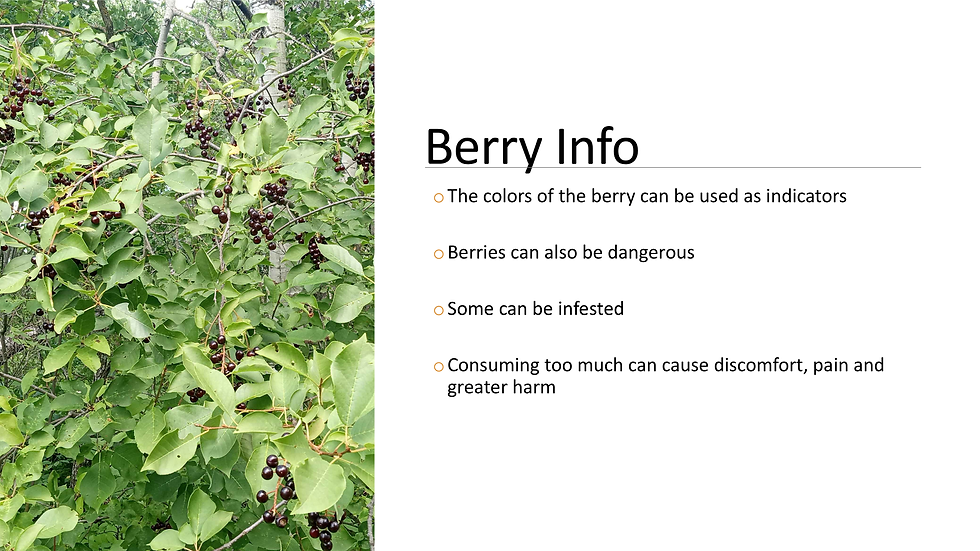
And what I've gathered from the berries, there's specific colors when you can pick it during its life cycle. Some can also be very dangerous. And then some can also be infested with parasites, larva, within it. And obviously consuming too much can cause discomfort, pain, and greater harm.
(0:10:59) such as nausea, stomach aches, and quite possibly the bathrooms.

Baneberries. This is a berry that I find most unique as it grows at a very low height, just about knee to waist. And so far there are two types. This one...
(0:11:25) i have is a white baneberry and then there's another that is a red baneberry it is highly poisonous and digested cause so much harm uh maybe even hospitalized with the way it gives off and it also grows in wet soils and shaded areas so you will see them mostly alongside rivers or creeks

(0:11:57) And for safety tips, wearing long sleeves. Almost the whole program I've been wearing nothing but sweaters. Appropriate footwear. Boots is most likely recommended. Hiking boots with the terrain that you'll be traveling on. And to carry some rubbing alcohol just in case if you ever encounter such plants. And obviously do not touch any plants that you do not know. Plants that you know are the ones that are okay to touch.

And so far what I've learned with the program, there's various types of grasses that are native and some that are not native. There's one brand of grass that I'm starting to despise and that's Kentucky bluegrass. And I've also learned about the trees, the white trees specifically. There's birch and there's white poplar.
(0:12:56) I didn't even know much about poplar until now. Also, stink weeds can be used as a repellent to repel bugs with the aroma it gives off. We could just rip off a piece of the plant and latch it onto our clothes or bags even. And we also learned a method on how to treat a wound. There's an example there that I have received there where I got stung by a bee.
(0:13:26) Had to take off the common plantain, apply pressure, and wrap a bandage around. And how to safely remove a plant. I always thought just cutting the plant down as far as it can go and removing the seeds will stop it. But that only slows it down. We've got to take out the roots. And some roots can go quite a ways with its length. And about the yearly seasonal life cycles.
(0:13:54) I didn't know much about the perennials and then biannuals. That is a need to learn about, especially with some plants. Some can be more dangerous the first year and then be beneficial during the second year. And then I also noticed about the second opinion. It's always nice to have. I've learned that from Dave and Finn whenever they go out checking on a plant.
(0:14:22) one would have to verify if that's the actual plan i find it best not to travel alone so have someone accompanying with you.

Right here is uh four spots where i've taken pictures that are most memorable and throughout the our journey the top left is turtle mountain it's at the summit in mulliams lake
(0:14:51) In the far top right, that is Spruce Woods and Spirit Sands. The bottom left is the Morden Valley. And, of course, I will not leave out Swan Lake. That's where I'm from. And, yeah, that's everything.


Comments